


Indoor plants thrive when the air around their leaves pulls just the right amount of water out. If the air is too dry or too wet, your crops will struggle to breathe and feed correctly. A VPD chart for indoor growing shows you how to balance heat and water vapor before plant stress takes hold.
Shop humidity controllers to keep your grow room climate steady around the clock.
A vpd chart for indoor growing is a visual tool that helps you find the sweet spot between temperature and humidity for your plants. Vapor pressure deficit is the gap between the moisture in the air and the most moisture that air can hold. When you keep a steady deficit, your plants can breathe and move nutrients from their roots to their leaves with ease. Using a chart allows you to track target ranges as your garden moves from the early seedling phase into late flower. According to research from the National Institutes of Health, lowering this deficit can sustain plant function and improve your final harvest. By following these target ranges, you ensure your indoor garden stays healthy throughout every growth stage.
Setting up the right grow room starts with learning the science behind the numbers on your screen. You do not need a degree to master your garden, but you do need to know how air moisture affects plant health. The process starts when you learn What VPD means for indoor plants.
What VPD means for indoor plants
Vapor Pressure Deficit (VPD) is a way to measure the drying power of the air in your grow room. It shows the difference between the moisture in the air now and how much it could hold if it were full. For indoor growers, this number is far more useful than relative humidity alone. It tells you how fast your plants will lose water to the air.
How VPD works
The air around your plants can only hold a certain amount of water. When the air is warm, it can hold more moisture than when it is cool. VPD looks at both heat and moisture to find a single value. This value shows the pressure that pulls water out of your plants. If the pressure is too high, the air pulls water out too fast. If it is too low, the plant cannot move water at all.
Using a vpd chart for indoor growing helps you find the right balance for your space. These charts show you the sweet spot where the air is not too dry or too damp. By following a chart, you can make sure your plants stay in a healthy range. This keeps them from getting too much stress from the air around them.
Transpiration and plant health
Plants move water from their roots to their leaves in a process called transpiration. This process is the engine that carries nutrients through the plant. Air vapor pressure deficit acts as the main force that drives this movement. When VPD is in the right range, the plant can "breathe" easily through its pores.
If the VPD is too high, the air is dry. This can lead to water stress and leaf damage. The plant may close its pores to save water, which stops growth. On the other hand, a low VPD means the air is humid. This makes it hard for the plant to release water. This can lead to mold or rot because the water has nowhere to go. Proper care helps with maintaining optimal humidity levels for every stage of life.
If your VPD is consistently too low, you may need to reduce humidity; learn how to select the right equipment with our guide on what size dehumidifier for grow room is best for your setup.
Why humidity alone is not enough
Many growers rely on a simple humidity meter, but this only tells half the story. The link between temperature and humidity changes as your room gets warmer or cooler. A humidity reading of 60% feels different to a plant at 70 degrees than it does at 85 degrees.
VPD is a clear metric because it looks at these changes in temperature. It gives you a clear look at what the plant feels. When you use a VPD chart, you are looking at the climate the same way your plants do. This allows you to make better choices for your fans and humidifiers. It takes the guesswork out of your grow and leads to stronger, healthier plants.

How do you read a VPD chart for indoor growing?
A VPD chart for indoor growing helps you find the best air for your plants. It looks like a grid with many colors. Most charts list air temperature on one side and relative humidity on the other. By using these two numbers, you can find your vapor pressure deficit. This is a more precise way to grow than just checking humidity alone. It tells you just how your plants feel in their grow space.
Managing the relationship between temperature and humidity is key to plant health. A good chart shows if your room is too dry or too wet for the current stage of growth. This helps you avoid plant stress and keeps growth fast. When the air is right, your plants can breathe and drink with ease. Using a chart makes you a much better grower because you use real data instead of guessing.
Find your room numbers
First, you need to know the temperature and humidity in your grow space. Use a digital meter to get these numbers. Make sure the meter is near the top of your plants. This is where most of the work happens. Air at the top of the room may be hotter than air near the floor. You want to know the state of the air right at the canopy where the leaves are.
Once you have your numbers, find them on the chart. Most charts use rows for temperature and columns for humidity. Trace your finger across the row and down the column until they meet. The spot where they cross shows your current VPD value. This value is usually in kilopascals or kPa. It shows the drying power of the air in your room.
Check the kPa value
The number in the box tells you how hard the air is pulling water from your plants. A low number, like 0.4 kPa, means the air is moist. In this zone, plants may struggle to move water. A high number, like 1.6 kPa, means the air is dry. This can cause the leaves to lose water too fast. The colors on the chart often show the safe zones for clones, veg, or flower stages.
Proper levels help keep the stomatal function and photosynthesis of your plants high. If your kPa is too high, your plants may wilt to save water. If it is too low, they could face mold or slow growth. You want to stay in the green zone for your own growth stage. Each stage has its own need for moisture and air pressure.
Look at leaf temperature
Many charts assume your plant leaves are colder than the air. This is called a leaf temp offset. A common offset is minus 2 degrees. If your leaves are hotter or colder than that, your chart reading might be wrong. This is a key part of the math that many new growers miss. You can use an infrared tool to find the real leaf temperature for more care. Knowing the real leaf temp makes your VPD data much more useful.
- Pick a chart that matches your growth stage and leaf temp offset.
- Use a sensor to find the current air temperature in your grow tent.
- Find the relative humidity rate in the same area.
- Look for the temperature on the left side of the chart.
- Follow that row until you find the column for your humidity.
- Read the kPa number in the box where the row and column meet.
- Compare that number to the target range for your plant's age.
If your numbers are out of range, you can use tools like fans or humidifiers. You can also work on maintaining optimal humidity levels with a controller. This runs the process so your plants stay in the best zone all day and night. It takes the stress out of growing and helps you get a bigger harvest.
VPD target ranges by plant growth stage
Every plant stage has its own ideal air and moisture balance. Managing these levels is more than just checking your temperature. A vpd chart for indoor growing helps you find the sweet spot for your garden. By hitting these targets, you ensure your plants can move water and nutrients through their stems with ease.
VPD targets for seedlings and clones
Young plants have weak root systems and need low air stress to live. If the air is too dry, these small starts lose water faster than they can take it in. This leads to wilting or slow growth. For propagation, you should keep your VPD low, usually between 0.4 and 0.8 kilopascals (kPa). This soft environment protects soft leaves while the roots form.
During this phase, maintaining optimal humidity levels is your top task. High humidity keeps the VPD low, which stops the plants from drying out. You want the air to feel moist but not still. This balance helps the plant focus on root growth instead of fighting to stay hydrated.
Optimal ranges for vegetative growth
As plants grow larger leaves, they can handle more air stress. During the vegetative stage, you should aim for a VPD range of 0.8 to 1.2 kPa. This middle range helps healthy transpiration without causing stress. It helps the plant pull up more nutrients from the soil or water. This builds strong stems and thick leaves. Research shows that reducing water stress through proper VPD helps keep up photosynthesis and plant mass.
You can hit these targets by fine-tuning your garden's moisture with fans or humidifiers. If your VPD gets too high in this stage, your plants may close their leaf pores to save water. This stops growth and can lead to nutrient burn as salts build up in the leaves. Keeping an eye on your charts helps you avoid these common issues.
VPD for flowering and fruiting
The final stage of growth needs the most air stress to prevent mold and rot. During flowering or fruiting, a higher VPD of 1.2 to 1.6 kPa is best. This dryer air helps the plant move water fast. This is needed for large blooms or heavy fruit. But you must be careful not to let the VPD climb too high. Too much stress can still hurt the harvest.
| Growth Stage | VPD Range (kPa) | Primary Goal |
|---|---|---|
| Propagation | 0.4 - 0.8 | Root growth |
| Early Veg | 0.8 - 1.0 | Leaf growth |
| Late Veg | 1.0 - 1.2 | Stem strength |
| Early Flower | 1.2 - 1.4 | Bloom onset |
| Late Flower | 1.4 - 1.6 | Mold safety |
These ranges are starting points for most indoor gardens. Your specific crop may need small changes based on how it looks and grows. Always watch for signs of stress like curled leaf edges or slow fruit sets. Changing your settings by just a few degrees or a small shift in humidity can make a big difference in your final results.
Why leaf temperature changes your VPD reading
Most growers look at a room thermometer to find their Vapor Pressure Deficit (VPD). This number tells you the relationship between temperature and humidity in your grow area. But the air temp in the tent is not the only thing that matters. The air right at the surface of the plant can be different from the rest of the room. This tiny gap changes how much water your plants lose through their leaves.
Vapor Pressure Deficit is the main force that drives plant transpiration. It moves water and nutrients from the roots up to the canopy. If this force is too high, it creates stress for the plant. This stress can lead to dried leaves and poor growth. To get the best growth, you need to know the temperature of the leaves themselves. This is why a vpd chart for indoor growing often has settings for leaf temperature offsets.
The gap between air and leaf temp
In a perfect world, your leaves would be the same temp as the air. But in a grow room, this rarely happens. Lights, fans, and water use all change the leaf surface. High-power LED or HID lights can heat the leaves up. This makes the leaf hotter than the air around it. When the leaf is hot, the air inside it holds more moisture. This increases the deficit and makes the plant work harder to stay hydrated.
On the other hand, plants use water to cool down. This process is called transpiration. As water evaporates from the leaf, it carries heat away. This can make the leaf a few degrees cooler than the room. If you do not account for this, your VPD reading will be wrong. You might think your plants are happy when they are actually under stress. Proper managing your grow room atmosphere requires checking both numbers.
Using infrared thermometers
The best way to find leaf temperature is with an infrared thermometer. These handheld tools let you take a reading without touching the plant. Point the laser at the canopy and pull the trigger. Try to check several spots. Look at the leaves directly under the lights and the ones in the shade. Average these numbers to find your leaf temp offset.
Most vpd charts assume a leaf temp that is 2 degrees cooler than the air. But your room might be different. If your offset is 5 degrees, your VPD will be much lower than the chart says. Using an infrared tool helps you fine-tune your environment. You can then adjust your fans or humidifiers to hit the right target for your growth stage.
How lighting and airflow affect leaves
Lighting is the biggest cause of heat on the leaf surface. Intense light adds energy to the plant tissue. If your airflow is low, this heat stays trapped on the leaf. This is why good ventilation is so important. Moving air helps strip away the warm, moist layer around the leaf. This allows the plant to breathe and cool itself better.
When you have strong lights and low air movement, your leaf temp will spike. This raises the VPD and can cause the plant to shut down. The plant closes its pores to save water. This stops growth and can lead to nutrient burn. By tracking leaf temp, you can spot these issues early. You can then move your lights or add a fan to keep the leaves in the safe zone.
How to adjust temperature and humidity for VPD
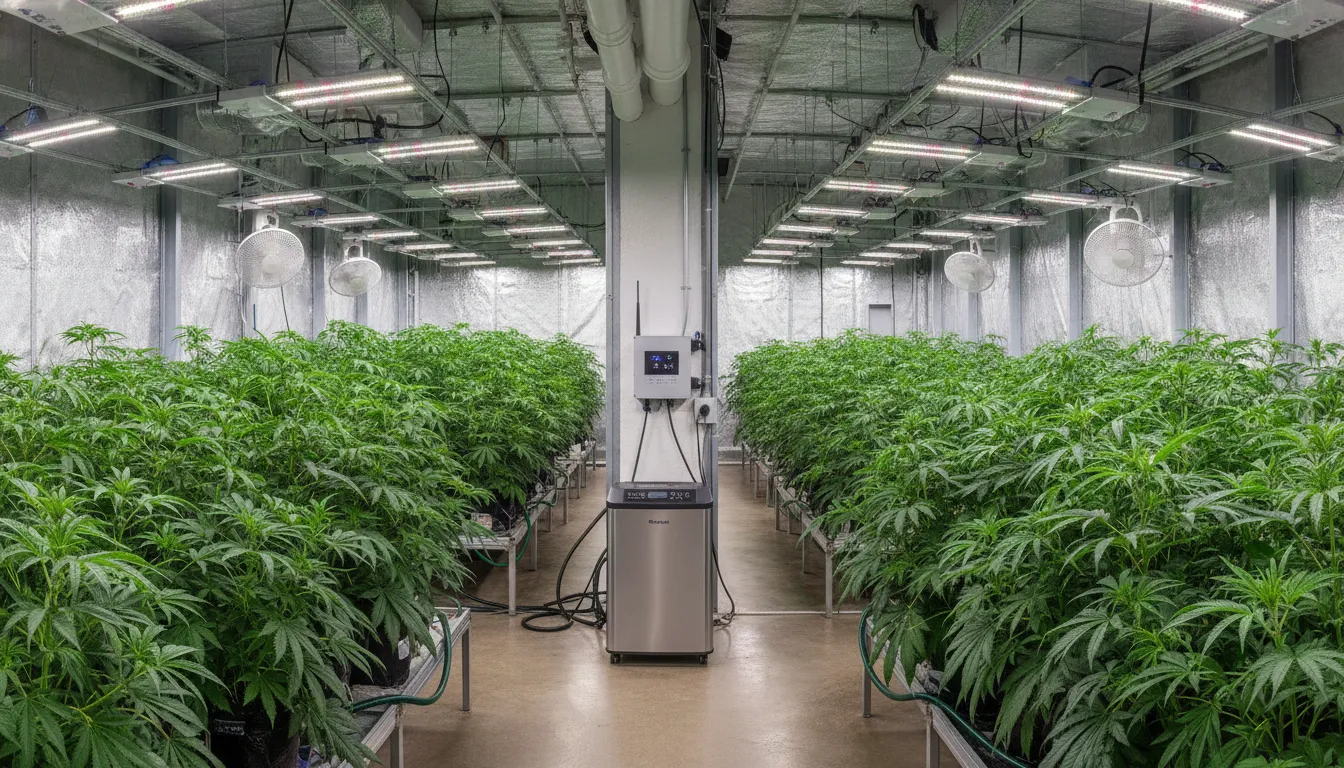
Managing the air in your grow room takes a lot of care. You must track both heat and moisture to keep your plants in the green zone of a vpd chart for indoor growing. When your levels drift too far, you need to act fast to fix the space. Using the right tools and gear helps you stay in control. Small shifts in how you run your fans or lights can make a big difference in plant health.
Lowering high VPD levels
- Reduce canopy temperature by dimming or raising lights.
- Add moisture with a properly sized humidifier.
- Improve airflow to prevent hot, dry pockets.
When your VPD is too high, the air is either too hot or too dry. This space puts a lot of stress on your plants. It forces them to lose water through their leaves much faster than they should. If this stays for too long, it can lead to leaf desiccation and poor growth. To fix a high VPD, you should aim to lower the heat in the room or add more water vapor to the air.
Start by checking your grow lights. High-power lights give off a lot of heat that can bake the air near your plants. You can dim your lights or move them further away to cool the canopy. You should also use a humidifier to pump moisture into the room. Adding more water to the air lowers the VPD and helps the leaves stay hydrated. Better airflow is also key. Using intake fans to bring in cool air from outside can help drop the heat fast. This keeps the air fresh and stops hot spots from forming around your plants.
Raising low VPD levels
Low VPD means the air is too wet or too cold. This is a big problem because it stops plants from moving water and nutrients from their roots to their leaves. If the air is too damp, the plants cannot breathe well. This can lead to slow growth and may cause mold or rot to set in. To raise your VPD, you must warm up the room or pull moisture out of the air.
You can raise the heat by turning up your heater or using the heat from your grow lights. If your room is too damp, you will need to use grow room dehumidifiers. These tools pull water out of the air to help dry out the space. Make sure your exhaust fans are running at the right speed. Strong fans will pull the old, wet air out of the tent and bring in drier air. This move helps your plants lose water at a healthy rate so they can grow strong and stay free of disease.
Using tools for better control
Checking your room by hand takes a lot of work and is hard to do all day. Most growers use smart tools to keep their rooms steady. High-quality humidity controllers can turn your gear on and off based on the live data from the room. These tools make sure your fans and humidifiers only run when they are needed. This saves power and keeps the air in the best range for your plants at all times.
Always make your changes in small steps. Fast jumps in heat or moisture can shock your plants and stunt their growth. It is best to adjust your gear over a few hours so the plants can adapt to the new air. Check your sensors often to make sure they are giving you the right facts. Having the right tools makes it easy to follow your chart and hit your growth goals. With a steady hand and the right gear, you can build the perfect home for your indoor garden.
Common VPD mistakes and how to avoid them
Managing your garden with a vpd chart for indoor growing helps your plants thrive. But even small errors in how you read or use the data can stall growth. Understanding these common pitfalls is the first step toward a more stable environment.
Ignoring leaf temperature
Many growers look only at the air temperature and humidity in their tent. This is a mistake because a true vapor pressure deficit (VPD) calculation depends on leaf temperature. Plants cool themselves through a process called transpiration, so leaves are often cooler than the air around them. If you do not account for this gap, your VPD reading will be wrong. Using an infrared thermometer to check leaf surface temperature ensures your math matches reality.
High VPD can cause plants to lose water too fast, which leads to leaf stress and poor growth. According to research on plant water stress, maintaining a proper balance prevents hydraulic limits that can damage your crop. Checking leaf temperature helps you stay in the safe zone.
Relying on one sensor
Using a single sensor to manage a whole room is risky. Air does not stay still, and "dead spots" often have different humidity levels than the rest of the space. To avoid this, place multiple sensors around your garden. Put some at the canopy level and others near the floor. This gives you a full view of your grow room atmosphere.
Bad sensor placement leads to chasing numbers that do not exist across the whole room. If your sensor sits directly under a light or in front of a fan, it will give a false reading. Try to keep sensors in shaded areas at the height of your plants for the most useful data. This helps you make better choices for your environmental controls.
Making abrupt changes
When you see your VPD is off, it is tempting to fix it fast. But plants do not like sudden shifts in their world. Rapid changes in humidity or heat can shock your plants and slow down photosynthesis. It is better to make small, slow moves to reach your target. This gives the plant time to adjust its breathing pores, or stomata, to the new air.
You should also plan for day and night shifts. When the lights go off, the temperature drops and humidity often rises. This can spike or crash your VPD in a short time. Using humidity controllers can help automate these transitions. Gradual moves keep your plants' water transport steady and help them grow more fruit and biomass.
Compare grow room dehumidifiers before excess moisture pushes VPD below your target range.
Choosing equipment for reliable VPD control
To hit the targets on your vpd chart for indoor growing, you need the right tools. Your environment changes often, so your gear must keep up. Using the right sensors and controllers helps you stay in the sweet spot for plant health. This balance is key because atmospheric vapor pressure deficit is the main force that drives water transport through your plants. Without good tools, your crops may face stress that slows their growth.
Accurate sensors and smart controllers
The first step is getting good data. You cannot fix what you do not measure. A standard thermometer is not enough for a precise grow room atmosphere. You need a hygrometer to track moisture and an infrared tool to check leaf surface temperature. Smart controllers can link these sensors to your fans and pumps. These devices automate the work of maintaining optimal humidity levels throughout the day and night.
Humidifiers and dehumidifiers
Moisture control is the biggest part of hitting your VPD goals. If the air is too dry, your plants may lose water too fast. This stress can lead to leaf drying and limited water flow. A high-quality humidifier helps you add moisture when the air gets too thin. In small setups, a portable unit works well. For larger rooms, you might need a system that links to your water line. This saves time and keeps your levels steady.
When the air is too wet, you need a strong dehumidifier. Excess moisture can cause mold and stop plants from feeding. You should pick a unit based on your room size and how much water your plants drink each day. Look for models with built-in pumps to handle drainage. These tools are essential for fine-tuning your garden's moisture. Using them with a controller ensures your VPD stays on track even as your plants grow and transpire more.
Frequently Asked Questions
Why is VPD more important than relative humidity?
VPD measures the actual drying power of the air. Relative humidity only tells you how much water is in the air. It does not show how heat changes the air's ability to hold moisture. According to GroIndoor, VPD is more precise because it tracks the link between heat and moisture. This helps you know if your plants can breathe and drink well. Using VPD prevents stress and helps plants grow much faster than using humidity alone.
Is 1.7 VPD too high for indoor plants?
A VPD of 1.7 kPa is often too high for the early and middle stages of growth. High levels like this can cause plants to lose too much water through their leaves. This leads to stress and slow growth. Research from PMC shows that high VPD can cause leaf drying and limit water flow. You should only use high VPD levels during the late flower stage to prevent mold. Lower your VPD to keep your plants healthy.
How can I lower VPD in my grow tent?
To lower your VPD, you must either cool the air or add more moisture to the room. You can use a humidifier to raise the moisture levels in your grow tent. Another way is to lower the room temperature with fans or air cooling systems. Bringing in fresh air from outside can also help if the air is cool and moist. These small changes reduce the drying power of the air. This helps your plants keep more water and stay healthy all day.
Does leaf surface temperature affect VPD?
Yes, leaf surface temperature is very important for getting a correct VPD reading. The air right at the leaf surface is often cooler or warmer than the room air around it. This difference changes how fast water leaves the plant through the leaves. As GroIndoor notes, ignoring leaf temperature can lead to wrong readings. You should use a simple tool to find the true leaf temperature. This helps you pick the right spot on your VPD chart for better results.
Ready to master your grow room environment?
Keeping your grow room climate in the right range is the key to a great harvest. If you ignore these vital checks, your plants will suffer from slow growth or rot. Pests and mold thrive when humidity and heat are not in check. This can waste your time and your money. Do not wait until your leaves start to wilt or spot to make a change. When you act now to fix your climate, you give your plants the best chance to thrive. You will see faster growth and better yields in every stage. Using the right tools makes this job much easier. You can stop guessing and start growing with ease today. A stable garden is a happy garden. Taking charge of your setup now will pay off when it is time to cut and dry. Your plants need the right air and moisture to grow their best. Every day counts.
Ready to contact our team? Visit our store to shop humidity control equipment.
Tags: