


When comparing LED grow light bars vs panels, bars usually provide more uniform edge-to-edge coverage and spread heat across a wider frame. Panels concentrate output in a compact fixture, making them easier to hang in smaller tents and often less expensive upfront. The best choice depends on your footprint, clearance, airflow, and budget.
Browse GroIndoor's complete LED grow light collection to compare fixtures for your space.
LED grow light bars vs panels at a glance
Both designs use efficient LED diodes, but the arrangement of those diodes changes how each fixture behaves. A bar fixture places diodes across several narrow rails with open space between them. A panel places many diodes on one compact board or housing. Fixture shape affects coverage, heat distribution, hanging options, and the number of lights a room may need.
| Decision factor | LED grow light bars | LED grow light panels |
|---|---|---|
| Coverage pattern | Broad, uniform spread with softer edges | Strong center intensity with more edge drop-off |
| Heat distribution | Spread across multiple rails | Concentrated around one board and heat sink |
| Hanging flexibility | Best for wide canopies and benches | Simple fit for compact or square spaces |
| Upfront price | Often higher because of the larger frame | Often lower for comparable entry-level output |
| Ideal footprint | Large tents, long benches, and broad canopies | Small tents, single zones, and tight layouts |
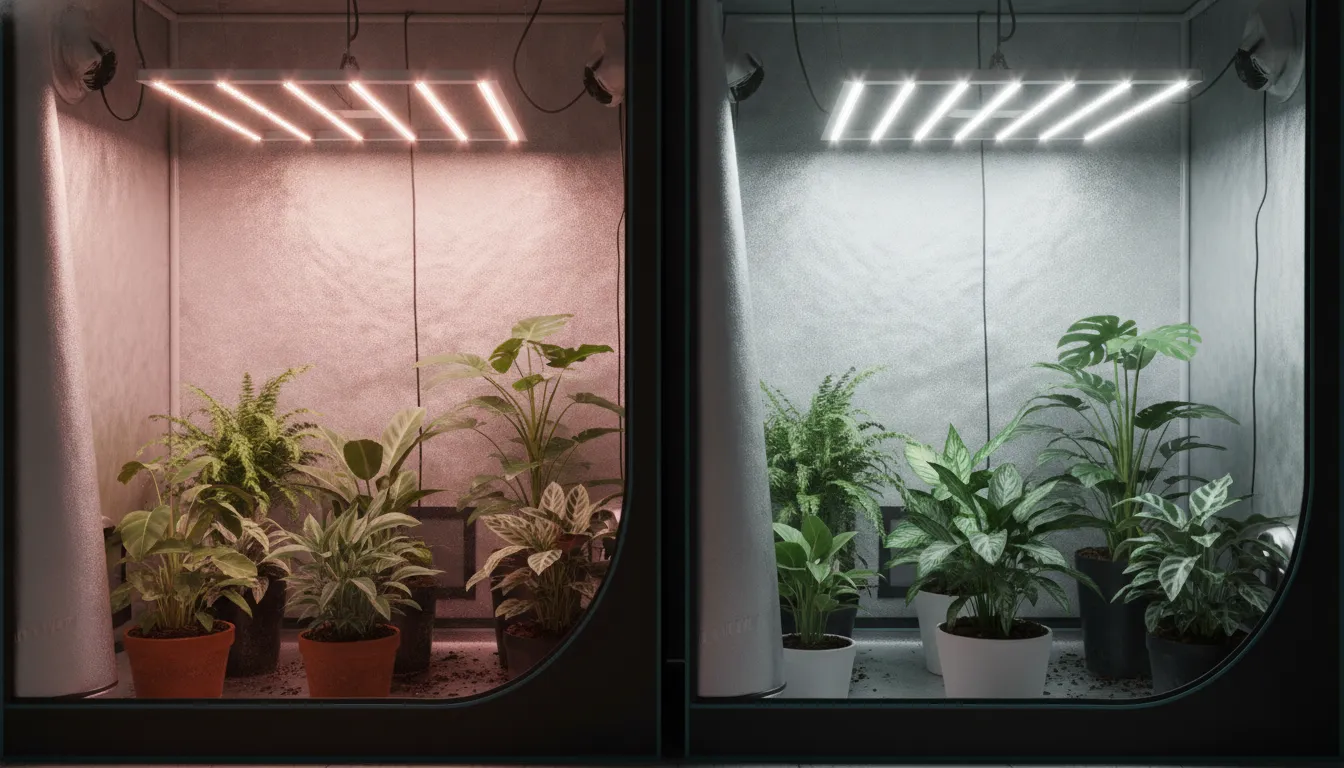
Start with fixture shape, then compare the product's actual wattage, efficacy, recommended coverage, dimming controls, and warranty. GroIndoor carries dedicated collections for LED grow light bars and LED grow light panels, which makes it easier to compare products within the design that fits your layout.
Which design delivers more uniform coverage?
Bar fixtures usually win on coverage uniformity. Separating the diodes across multiple rails creates more points of light over the canopy. Light reaches the center, edges, and corners from several angles instead of mainly from one concentrated source. That can reduce the difference between the brightest and dimmest areas of a wide footprint.
Uniformity matters because a fixture's center reading does not describe the whole garden. A powerful hotspot can make the middle look impressive while the outer plants receive less light. A bar frame is designed to reduce that tradeoff, especially over long benches or large square tents. The open frame also lets more light reach plants at an angle, which can improve coverage around the sides of a dense canopy.
Panels can still cover a small footprint well. Their compact diode layout delivers strong light directly beneath the fixture, and one panel is simple to center over a single growing zone. In a larger room, however, several panels may be needed to create the same edge-to-edge consistency as a broad bar fixture. That adds more hangers, cords, and placement decisions.
How to compare coverage claims
Do not choose by maximum center intensity alone. Look for a PPFD map that shows measurements across the full recommended footprint at a stated hanging height. Compare the corners and edges with the center. Also check whether the map was recorded in a reflective tent or an open room, because reflective walls can raise edge readings.
For a practical reference point, see GroIndoor's guide to the best grow lights for a 4x4 tent. It shows why matching the fixture to the complete footprint matters more than selecting a light from wattage alone.
How do bars and panels distribute heat?
LED fixtures still produce heat even though they are more efficient than many older lighting technologies. The key difference is where that heat accumulates. A bar fixture spreads diodes and heat across several rails. Air can move between the rails, and the larger surface area helps prevent one concentrated hot zone above the canopy.
A panel puts its diodes and heat sink into a smaller area. That compact shape is convenient, but the area above the fixture may feel warmer. Good exhaust and circulation can manage that heat in a small tent. In a room with several panels, the concentrated heat zones may require more deliberate fan placement.
Driver placement changes the result
The driver also contributes heat. Some fixtures allow the driver to be mounted away from the light, which can move part of the heat outside the growing area. Check the product specifications before assuming that a bar or panel has a remote-driver option. The frame style alone does not determine total room temperature.
When planning ventilation, compare actual fixture wattage and the number of fixtures, not only design type. Two lower-wattage panels may create a different airflow challenge than one large bar fixture. Leave the manufacturer-recommended clearance around every fixture and keep circulation paths open.
Hanging flexibility and ideal footprints
The best fixture is the one that fits the canopy without creating clearance or access problems. Bar lights tend to occupy more horizontal space. That makes them a natural match for broad canopies, long garden benches, and larger tents. Their wide frame can cover an area with fewer fixtures, but the frame dimensions must fit through the opening and leave room for ventilation equipment.
Panels are easier to place in compact or divided growing areas. A panel can be centered over one zone, moved independently, or arranged with other panels around ducts and support poles. This modular approach is useful when different plants have different heights or when the layout changes often.
Match shape to the room
- Small square tent: A compact panel is often simple to center and adjust.
- Large square tent: A multi-bar fixture can improve corner coverage with one broad frame.
- Long bench: Bar fixtures or a planned row of panels can follow the canopy's length.
- Divided zones: Multiple panels offer independent height and dimming control.
- Low-clearance room: Compare the complete hanging depth, including ratchets and driver position.
If you are building a larger setup, compare the wider fixtures in GroIndoor's bar-style LED light selection. For a tight or modular layout, review the compact LED panel selection.
Compare bar-style fixtures for broad, even canopy coverage.
Does fixture shape change efficiency or price?
Fixture shape does not automatically determine efficiency. Efficacy depends on the diodes, driver, operating power, and complete fixture design. Compare products using the manufacturer's efficacy rating, actual power draw, dimming range, and full-footprint light map. A high-quality panel can outperform a basic bar fixture, and the reverse can also be true.
Price often reflects frame size, materials, diode count, controls, and warranty. Bar fixtures commonly cost more upfront because their frames are larger and more complex. Panels often provide an accessible starting point, especially for a small footprint. The lowest purchase price may not be the lowest total cost if several panels are needed to cover the same area as one bar fixture.
Use real products as reference points
Specific models help make the comparison concrete. The Growers Choice ROI-E900 LED Grow Light represents the broad-fixture end of the market, while the Horticulture Lighting Group HLG 650R provides another useful product reference. Compare each current product page for dimensions, wattage, coverage guidance, controls, and warranty before buying.
For more context on output levels, GroIndoor's 1000W LED grow light guide explains how high-output fixtures differ. The full-spectrum LED light guide helps separate spectrum decisions from fixture-shape decisions.
Pros and cons of LED grow light bars vs panels
LED grow light bars
- Pros: More even coverage across wide footprints, fewer concentrated hotspots, open airflow paths, and a strong fit for broad canopies.
- Cons: Larger frame, often higher upfront price, and less convenient in small or divided spaces.
LED grow light panels
- Pros: Compact shape, straightforward hanging, flexible placement, and often a lower entry price.
- Cons: Stronger center concentration, more edge drop-off in large spaces, and concentrated heat around the board.
Neither design is universally better. Bars are usually the stronger choice when uniformity across a large canopy is the priority. Panels are often the practical choice when the garden is small, modular, or budget-sensitive. Product quality and correct sizing still matter more than the label alone.
How to choose the right LED grow light
- Measure the growing footprint. Record usable length, width, and vertical clearance, not just the room dimensions.
- Choose a coverage goal. Decide whether one broad fixture or several independently placed fixtures better matches the canopy.
- Review a full PPFD map. Compare edge and corner readings with the center at a realistic hanging height.
- Plan heat and airflow. Check driver placement, actual wattage, exhaust capacity, and space around the frame.
- Compare total cost. Include the number of fixtures, hangers, controls, and any ventilation changes.
- Check practical details. Confirm dimensions, dimming, voltage, warranty, and manufacturer coverage guidance.
A first-time buyer with a compact tent may value a panel's simple installation and lower entry price. A grower covering a large, level canopy may get better uniformity from a bar fixture. If you still need a broader overview, read GroIndoor's LED grow light buyer's guide before comparing individual models.
Shop LED grow light panels for compact and flexible layouts.
Check the complete installation before ordering
Fixture dimensions are only one part of the fit. Add the height of the hangers, ratchets, driver, and required clearance above the light. Then check where exhaust ducts, circulation fans, support poles, and electrical connections will sit. A frame that matches the canopy on paper can still be awkward if it blocks airflow or leaves no room to raise the light.
Also decide how often the layout will change. One broad bar fixture keeps a level canopy simple, while several panels let you adjust separate zones. Independent fixtures can be useful for plants at different heights, but every added light needs a safe power connection and its own secure hanging points. Make sure the combined load fits the electrical circuit and follow each manufacturer's installation instructions.
Finally, compare the warranty and replacement process. A low initial price is less attractive if the fixture lacks dependable support. GroIndoor's product pages let you review current specifications before making a final choice.
Frequently asked questions
Are LED grow light bars better than panels?
Bars are usually better for uniform coverage across a broad canopy, while panels are often better for compact spaces and modular layouts. The right choice depends on footprint, airflow, clearance, and the specifications of the individual fixture.
Do LED grow light bars run cooler than panels?
Bars spread heat across multiple rails and allow air to move through the frame, so they often avoid one concentrated hot area. Total room heat still depends primarily on actual wattage, driver placement, ventilation, and the number of fixtures.
Are LED grow light panels less expensive?
Panels often have a lower upfront price because they use a compact frame. Compare total coverage cost, however. A large space may require multiple panels, hangers, and cords where one broad bar fixture could provide the needed coverage.
What should I compare besides fixture shape?
Compare actual wattage, efficacy, the complete PPFD map, dimensions, dimming range, voltage, driver placement, warranty, and manufacturer-recommended coverage. These details reveal more about performance than bar or panel shape alone.
Find the right light for your layout
Choose bars when broad, uniform coverage and distributed heat are the priorities. Choose panels when compact size, independent placement, and entry price matter most. Measure first, verify the complete specifications, and compare products that match the same real-world footprint.
Explore all LED grow lights at GroIndoor and choose a fixture built for your indoor garden.
Tags: