


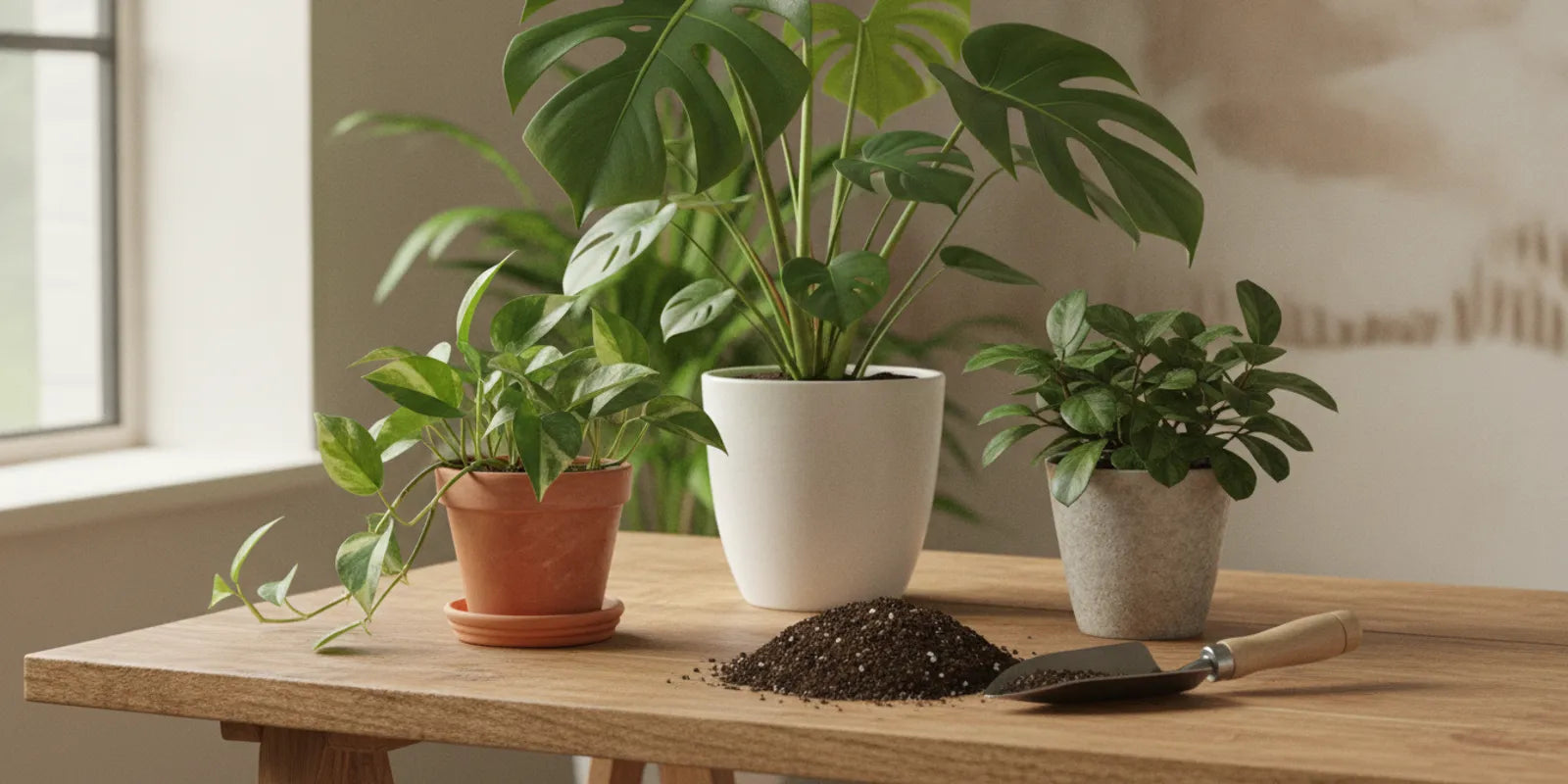
Choosing potting soil for indoor plants starts with the plant's roots, not a universal recipe. A good mix holds enough moisture for the plant while leaving air spaces and allowing extra water to drain; the right balance depends on the plant, pot, and growing conditions.
Explore an indoor potting mix option
What does a good indoor potting mix need to do?
Roots need water, oxygen, and room to grow. Potting medium helps provide these conditions and supports the plant in its container. A mix that stays waterlogged can limit air around roots. A mix that dries very quickly may leave roots short of usable moisture. The aim is not to make every pot drain as fast as possible. It is to find a workable balance for the specific plant and care routine.
Think of a potting mix as a combination of functions. Fine particles can hold water and nutrients. Larger or more open components create pore spaces that help water move and air reach roots. Organic materials can change how much moisture a mix retains as they break down. Ingredient names alone do not tell the whole story: particle size, proportions, and how the finished blend behaves in a container all matter.
For that reason, “potting soil” does not always mean actual garden soil. Commercial potting products may use different ingredients and may be labeled for particular plants or uses. Check the product label for its intended application and directions. Cornell Cooperative Extension describes potting mixes made with components such as coarse sand, pumice or perlite, and peat moss, while noting that many potted plants can grow well in a suitable mix. That is a starting point, not a single formula for every indoor plant (Cornell Cooperative Extension's indoor plant material).
How do you match a mix to the plant?
Start by identifying the plant, then look up its broad growing preference from a reliable plant-care source or the grower's instructions. Consider whether it naturally grows in a consistently moist environment, in a substrate that dries between waterings, or in a mix with especially open drainage. Those differences affect what the root zone needs. Avoid treating a product marketed as “all purpose” as automatically ideal for every plant.
- Plants that prefer even moisture: Look for a mix that holds some water but still drains freely. Check it after watering, rather than assuming that moisture retention means the roots should stay saturated.
- Plants that prefer drying between waterings: Favor a more open structure and use a container with drainage. A dense, persistently wet medium can make it difficult to manage the dry-down period.
- Plants with fine or delicate roots: Avoid coarse chunks that leave roots unsupported or large voids around a small root ball. Use a texture suited to the plant and its current pot size.
- Plants that grow in specialized conditions: Follow a mix recommendation for that plant rather than improvising from a general houseplant blend. Some species are not well served by standard potting soil.
These are broad selection principles, not strict rules for every species. Two plants with similar leaves can have different root and moisture needs. If a plant has a nursery label or care instructions, use those to narrow the choice. When repotting a plant that is already healthy, changing its growing medium and watering routine at the same time can make it harder to tell how it responds.
Which ingredients should you look for?
Read the ingredients and product description as a whole. A name such as peat, coir, bark, perlite, or compost indicates a component, but it does not reveal the proportion or final texture on its own. Look for the mix's intended plants, whether it is designed to retain moisture or drain readily, and any directions about preparation, feeding, or use.
| Mix feature or component | What it can contribute | What to check before choosing |
|---|---|---|
| Fine, moisture-holding materials | Can help keep water available around roots. | Will the mix remain wet too long in your room, pot, and watering routine? |
| Coarse or porous components | Can make the structure more open and support drainage and air spaces. | Is the particle size suitable for the plant and the scale of its root ball? |
| Bark or other larger pieces | Can create a chunkier texture in some blends. | Does the plant call for that texture, and do pieces leave roots adequately supported? |
| Pre-amended or nutrient-containing mix | May supply nutrients as described on its label. | What does the label say about duration, additional feeding, and plant suitability? |
The table describes general roles, not guaranteed performance. The same ingredient can behave differently depending on how it has been processed and blended. Follow the package label, and do not add extra fertilizer simply because a component sounds “natural” or because the plant is indoors. If the mix is pre-amended, check the feeding directions before adding anything.
For example, products in the soil and soilless-mix category include coco coir and soilless mixes, while other examples are listed as Coco Loco potting mix and Formula 707 growing mix. These are examples to compare by their product descriptions and labels, not interchangeable recommendations for every plant. Also consider the product listing and the Ocean Forest potting soil listing when assessing labeled use and ingredients.
How do you check drainage and aeration in a pot?
Drainage is the movement of excess water out of the container. Aeration is the presence of air in spaces between particles. They are related, but they are not the same thing. Water passing through a pot does not prove that the mix holds the right amount of moisture, and water sitting in a saucer does not tell you exactly what is happening around every root.
Before planting, dampen a small amount of mix according to its label and handle it gently. A mix that forms a dense, sticky mass when wet may be difficult to manage for a plant that needs an airy root zone. A blend that falls through your fingers very quickly may need more frequent checking for moisture, depending on the plant. Do not compact the medium tightly just to make a pot feel full; firm it lightly enough to support the plant.
Use a container with open drainage holes unless the plant's growing method specifically calls for another arrangement. A decorative cachepot can hold a nursery pot, but empty water from the outer pot after watering. A layer of stones at the bottom does not substitute for a drainage hole, and can leave the root zone sitting above trapped water. Match the container size to the root ball: a much larger pot holds more unused medium, which can take longer to dry.
Container shape and material also affect how quickly a pot dries. A small plastic pot in a cool room may behave differently from a wide, porous container under strong grow lights. Treat watering as something to observe and adjust, not a fixed calendar task. GroIndoor's guide to how often to water indoor plants covers moisture checks in more detail.
What changes when you choose a pot or growing system?
The best medium depends partly on the container and growing method. For ordinary potted houseplants, choose a mix that is labeled for the intended use and pair it with a pot that drains. A standard soil-based potting mix is not automatically suitable for every hydroponic system. Hydroponic methods can use water and other media differently, so choose supplies designed for the particular system rather than treating soil as a universal substitute.
If you are comparing pots, look at the drainage design and the amount of space the roots need, not just the outside dimensions. For instance, a 2-gallon fabric pot listing and a mesh-bottom pot listing are different container examples; select based on plant size, medium, and watering setup. Keep the medium and container choice together in your plan. A suitable mix in a pot that traps excess water can still create root-zone problems.
For growers considering a water-based system, browse the hydroponics collection and check that the components suit the system you intend to use. Do not switch a plant from potting soil to a hydroponic setup by simply removing the soil and placing the roots in water. The growing method, support, water management, and plant adaptation all need consideration.
Should you amend a potting mix yourself?
Amending a mix can help tailor its texture, but it also makes the result less predictable if the ingredients and proportions are not understood. First ask whether the plant actually needs an adjustment. If the current medium supports healthy growth and drains appropriately for that plant, changing it is not automatically an improvement.
When a change is warranted, use a small, measured adjustment and keep notes. A grower may add a porous component to make a blend more open, or combine compatible media to change how the mix holds water. The result depends on the starting product, particle sizes, pot, and plant. Do not rely on a generic recipe as a substitute for the mix's label or species-specific guidance. Cornell Cooperative Extension's indoor-plant material discusses prepared mixes with several possible components; it does not make one ingredient ratio a universal indoor-plant standard (review the Cornell material).
Avoid adding garden soil to a houseplant pot without a clear reason and suitable preparation. Garden soil can be dense in a container and may not behave like a manufactured potting medium. Also avoid piling on fertilizer, compost, or amendments to “fix” a plant that is declining before checking watering, light, pests, and root condition. More ingredients do not necessarily mean a better root environment.
Virginia Cooperative Extension's indoor plants chapter includes a recipe note about adding superphosphate to a prepared potting soil after repotting (Virginia Cooperative Extension's indoor plants chapter). Treat such directions as a specific reference, not a blanket instruction: fertilizer choices should match the plant, the medium, and the product label. If a commercial mix already contains nutrients, adding more may be unnecessary.
Compare soil and soilless mix options
How can you tell if the mix is working?
Observe the plant and medium over time rather than judging the mix from a single watering. After watering, excess water should be able to leave the pot, but the root zone should not necessarily become dry at once. Check moisture at more than the surface. The top may look dry while lower portions remain wet, especially in a deep pot or a dense medium.
- Water remains on the surface: The medium may be very dry, compacted, or difficult to wet evenly. Apply water slowly and see whether it soaks in; if the problem repeats, reassess the medium and root condition.
- The pot stays heavy and wet for a long time: Check drainage holes, container size, room conditions, and watering amount. A slow dry-down can have several causes, so do not assume the soil alone is responsible.
- The plant wilts soon after watering: Check whether water is reaching the root ball and whether roots are healthy. Wilting can have multiple causes and is not proof that the mix needs more water.
- Roots circle tightly or emerge from holes: The plant may be ready for a larger container, but inspect its overall condition before repotting. Moving it into an oversized pot can make moisture management harder.
Change one factor at a time when possible. If you change the mix, pot, watering schedule, and light exposure all at once, you will have fewer clues about what helped or caused a problem. Keep a simple record of the plant, mix, container, and how long it takes the pot to dry. That observation is more useful than relying on a universal watering timetable.
What is a practical way to choose potting soil?
- Identify the plant. Find out whether it prefers steady moisture, a drying interval, a coarse medium, or a specialized substrate.
- Check the label. Confirm that the product is intended for the plant or general use you have in mind. Read ingredient and feeding directions.
- Match the texture and container. Consider particle size, pot depth, drainage openings, and root-ball size together.
- Plan how you will check moisture. Room temperature, light, airflow, and container material can affect dry-down, so be prepared to observe rather than guess.
- Repot carefully and monitor. Keep the plant at an appropriate depth, avoid crushing the medium, and watch how it responds before making additional changes.
This process helps narrow the choices without assuming a single product is right for all plants. If a plant is sensitive or already struggling, verify its growing requirements before repotting, and consider whether the root system needs attention as well as a different medium.
Review soil and soilless mix choices
Frequently Asked Questions
Is potting soil the same as garden soil?
Not necessarily. “Potting soil” is commonly used for a medium intended for containers, and products vary in their ingredients. Garden soil is made for outdoor ground conditions and may be too dense or behave differently in a pot. Check that a product is labeled for container use.
Can I use one potting mix for every indoor plant?
A general-purpose mix may suit a range of plants, but it is not automatically the best fit for every species. Compare the plant's moisture and root-zone needs with the mix label. Some plants call for a more open or specialized medium.
Do indoor plants need a pot with drainage holes?
For most potted plants, drainage holes make it easier for excess water to leave the container. If you use a decorative outer pot without holes, keep the plant in a draining inner pot and empty collected water rather than letting the roots sit in it.
How often should I replace potting soil?
There is no single replacement interval for every plant and mix. Consider repotting when the plant outgrows its container, the medium has broken down or become difficult to manage, or there is another clear reason. A calendar alone is not enough to determine that a plant needs fresh mix.
Choose potting soil by matching the plant's root needs, the mix's structure, and the container, then use the plant's response to guide any adjustments.
Tags: