


Air stones for hydroponics turn an air pump's output into bubbles that move through nutrient solution. The right combination of diffuser, pump, tubing, water depth, and placement helps maintain steady circulation around submerged roots. Use this guide to choose a practical starting size, test the setup, clean the diffuser, and troubleshoot weak bubbles without relying on the pump label alone.
Shop air pumps and air stones for your hydroponic setup.
Why do hydroponic systems use air stones?
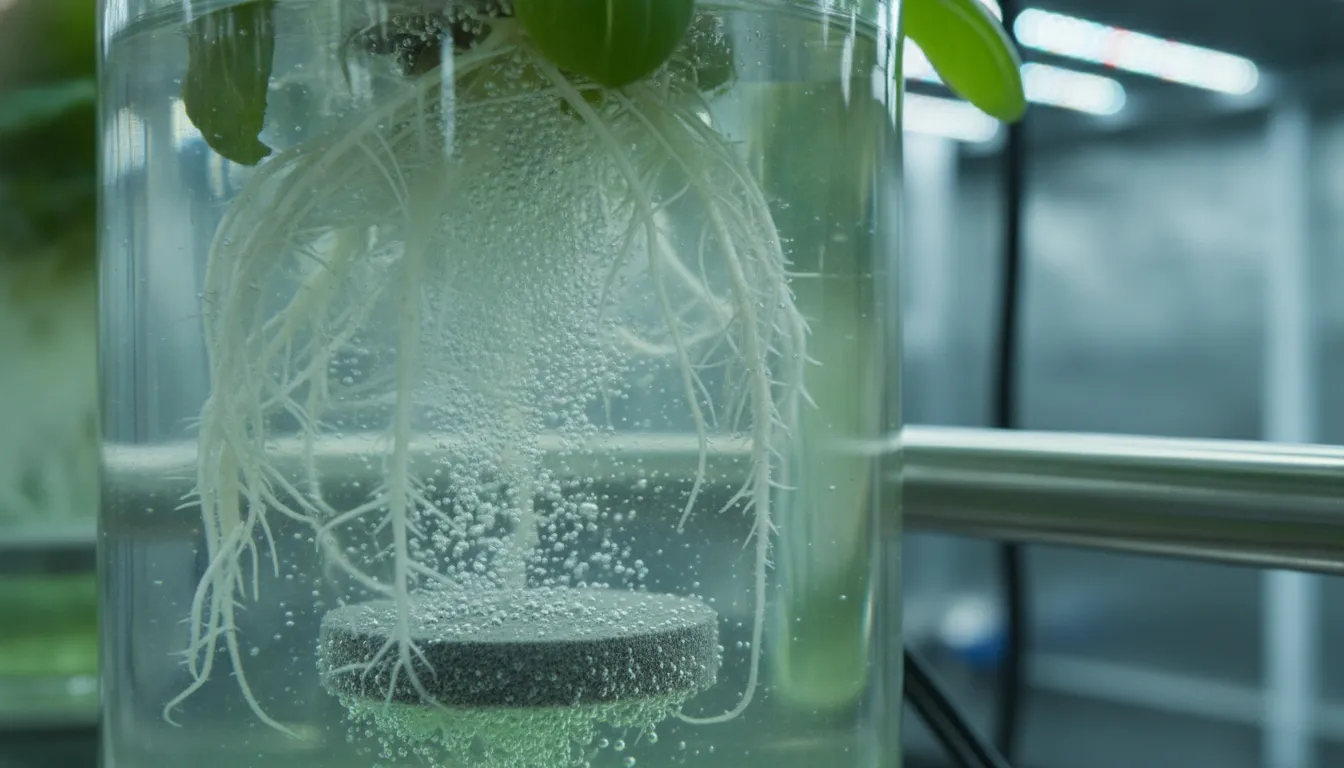
Roots need oxygen for respiration and nutrient uptake. In systems where roots remain submerged, an air stone helps replenish dissolved oxygen while rising bubbles move water through the reservoir. This is especially useful when circulation is limited or when a reservoir has broad areas with little surface movement.
An air pump pushes room air through tubing and into a porous stone or diffuser. The diffuser breaks that airflow into bubbles. As bubbles rise, they disturb the surface and create an upward current. Fine bubbles provide more water contact, but even output and useful circulation matter more than appearance alone. Air stones do not replace correct nutrient mixing, water-temperature control, sanitation, or regular root inspection. For related fundamentals, review GroIndoor's guides to hydroponic water temperature and properly mixing plant nutrients.
How are air stones different from air diffusers?
Air stone is a common name for a porous mineral or ceramic diffuser, while other diffusers may use a flexible membrane, plastic body, bar, or different pore pattern. Each design has a resistance level and a recommended airflow range. A fine-pore model may make smaller bubbles but require more pressure. A lower-resistance model may work better with a modest pump or a deeper reservoir.
Choose by operating pressure, reservoir shape, cleaning needs, and replacement cost rather than by bubble size alone. GroIndoor's guide to air diffusers and air stones explains the main format differences.
How do you size an air stone and pump?
Start with the reservoir's actual operating volume, not its maximum capacity. Then account for water depth, tubing length, splitters, check valves, manifolds, and diffuser resistance. Pump ratings are often measured with little or no backpressure. The useful number is the airflow the pump can deliver at your operating depth through the complete air path.
What airflow is a practical starting point?
A simple planning rule is about 1 liter per minute of air per gallon of nutrient solution. Treat this as a starting estimate, not a universal requirement. Plant size, root density, temperature, reservoir shape, diffuser design, and pump wear all change the result. Select adjustable output or modest headroom so you can tune the system until every diffuser produces consistent circulation without excessive splashing or noise.
| Operating reservoir | Starting airflow range | Diffuser starting point | Typical fit |
|---|---|---|---|
| 1-5 gallons | 2-5 LPM | One small disc or cylinder | Small buckets, seedlings, and herbs |
| 5-20 gallons | 5-20 LPM | One large or two small diffusers | Single-bucket or compact systems |
| 20-50 gallons | 20-50 LPM | Multiple diffusers with a manifold | Large reservoirs and multi-site beds |
| 50-plus gallons | 50-plus LPM | Multiple diffusers sized by flow at depth | Large or commercial-scale reservoirs |
Compare this table with the diffuser manufacturer's airflow range and the pump's flow-at-depth chart. A pump that claims 20 LPM at the outlet may deliver much less through a deep reservoir, long tubing run, check valve, and fine-pore stone. If specifications are unavailable, begin at a low setting, confirm an even bubble pattern, and increase gradually.
How do depth and backpressure change the choice?
Deeper water creates more pressure against the pump. Narrow tubing, long runs, sharp bends, check valves, manifolds, and clogged pores add resistance. When one pump feeds several reservoirs, the least restrictive branch can take most of the airflow unless branches are balanced.
- Check the pump's rated flow at your actual water depth.
- Keep tubing short, open, and free from sharp bends.
- Use a manifold with individual valves for multiple branches.
- Keep branch lengths and water depths as similar as practical.
- Leave capacity for gradual buildup between cleanings.
If a pump becomes unusually hot or loud, inspect the full air path instead of adding more restriction. Excessive backpressure can reduce output and shorten component life. For help choosing the pump that drives the system, see GroIndoor's hydroponic air pump selection guide.
Should you use one large stone or several smaller stones?
A large stone connected to an undersized pump may bubble across only part of its surface. A small stone connected to excessive airflow may create coarse bubbles, splashing, or unnecessary wear. In a wide reservoir, several correctly matched stones often distribute circulation more evenly than one diffuser in a corner. Match the configuration to the tank dimensions and root-zone layout, then confirm each branch independently.
Keep the growing method in mind as well. GroIndoor's guides to growing in rockwool, growing in coco coir, and hydroponic grow media cover different root-zone requirements.
Where should you place air stones?
Place each air stone near the bottom of the reservoir so bubbles travel through more water and create an upward current. The goal is broad circulation, not a dense bubble column in one corner. A centered disc can work in a round bucket. In a long or rectangular reservoir, space multiple diffusers so their currents reach different areas.
What is the air stone placement checklist?
- Map the root zone. Identify where roots hang now and where they will expand.
- Set the diffuser low. Keep it near the bottom without blocking an outlet or drain.
- Spread circulation. Space stones so currents cover the reservoir rather than one small area.
- Secure the tubing. Prevent a line from lifting the stone, kinking, or interfering with roots.
- Protect the pump. Keep it above the waterline or install a correctly oriented check valve.
- Observe the pattern. Look for even bubbles and movement across the surface.
Do not allow a growing root mass to completely cover a diffuser. Roots can restrict output and make inspection difficult. During reservoir service, reposition the stone gently if necessary. After setup, inspect areas where debris settles or the surface remains still. Recheck circulation after adding nutrients because residue can change performance. For broader equipment planning, browse GroIndoor's hydroponics collection.
Compare air pumps and air stones before you build or upgrade your reservoir.
How much airflow does a hydroponic reservoir need?
The right setting is the amount that maintains steady circulation and root-zone aeration without avoidable heat, noise, splashing, or equipment strain. There is no single setting for every crop or container. Adjust based on delivered airflow, operating depth, root density, and the condition of the nutrient solution.
How do water temperature and crop conditions affect aeration?
Warmer water holds less dissolved oxygen than cooler water, so temperature changes the conditions an air system must support. A dense mature root mass also affects circulation differently from a young plant. Monitor water temperature, root appearance, odor, water level, and bubble consistency. Address warm water or sanitation problems directly instead of relying only on more pump output. GroIndoor's guide to changing hydroponic reservoir water provides related maintenance context.
How do you balance a multi-reservoir system?
Start with every branch valve partly open. Compare the bubble patterns, then make small adjustments until the branches are reasonably even. Do not close most valves to force air through one difficult line, because that can create excess pressure. If one pump cannot deliver the required flow to every reservoir at depth, reduce the load or use an additional properly sized pump.
Keep spare tubing, check valves, and a clean diffuser available for systems that depend on continuous aeration. Inspect the pump according to its manual and keep electrical connections dry and safely positioned.
How do you clean and maintain an air stone?
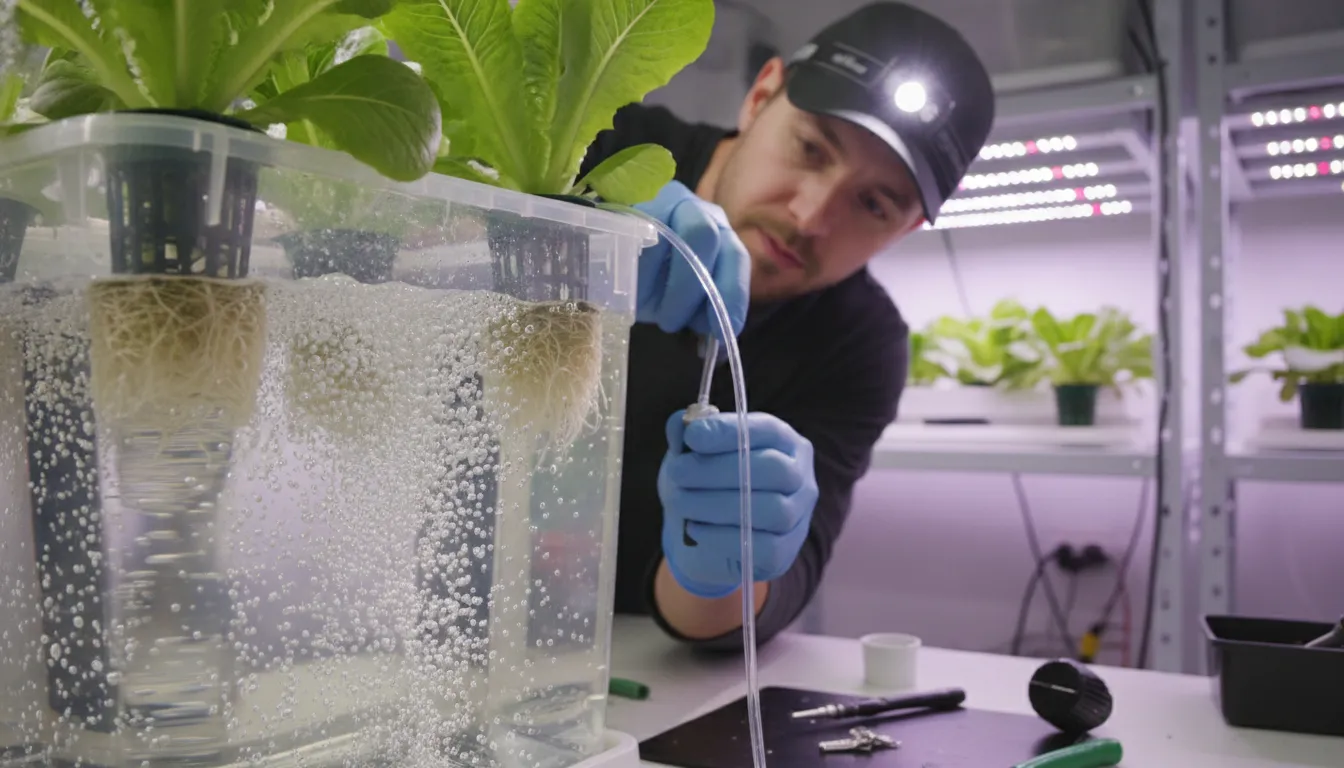
A gradual loss of bubbles can be easy to miss. Regular inspection catches mineral scale, algae, blocked tubing, and worn pump parts before circulation drops significantly. Follow the diffuser manufacturer's cleaning instructions because materials tolerate different treatments.
What should you check each week?
- Compare the current bubble pattern with the clean baseline.
- Look for weak sections, coarse bubbles, or a stopped diffuser.
- Inspect tubing for kinks, cracks, loose joints, and water intrusion.
- Confirm check valves face the correct direction and remain clear.
- Check for mineral crust, slime, algae, or trapped roots.
- Listen for new pump noise and check for unusual heat or vibration.
- Confirm every manifold branch receives airflow.
What are the safe cleaning steps?
- Turn off and unplug the pump before servicing the air system.
- Remove the stone carefully and rinse away loose residue with clean water.
- Use a soft brush to remove surface buildup without damaging the pores.
- Soak or sanitize only with a method approved for the stone material.
- Rinse thoroughly so no cleaning residue enters the nutrient solution.
- Let the diffuser dry if the manufacturer's procedure calls for it.
- Reconnect the system and confirm an even bubble pattern before returning it to service.
Do not use soap that can leave residue in the reservoir. Replace a diffuser that remains clogged, crumbles, cracks, or produces an uneven pattern after correct cleaning. Keeping a clean spare makes routine service easier. If deposits recur, review GroIndoor's guide to cleaning salt buildup in hydroponic systems.
Why is an air stone making weak bubbles?
Troubleshoot from the pump to the stone. Changing several components at once can hide the cause. Make one correction, then test the complete system again.
What is the fastest troubleshooting sequence?
- Confirm power and pump operation. Check the outlet, cord, controls, and setting.
- Inspect the tubing. Straighten kinks, reconnect loose joints, and replace cracked line.
- Check valve direction. A reversed or blocked check valve can sharply reduce flow.
- Test for an air leak. Listen near connections and close unused manifold ports.
- Compare branches. Swap lines to see whether the fault follows the stone or the branch.
- Test operating depth. A better result in shallower water may indicate insufficient pressure.
- Clean or replace the stone. Deposits and biological growth can block pores.
- Evaluate the pump. If every branch remains weak, service or replace the pump according to its manual.
| Symptom | Likely cause | First check |
|---|---|---|
| No bubbles from one stone | Kink, closed valve, clog, or loose connection | Swap the stone onto a working line |
| All stones are weak | Pump setting, leak, excess depth, or pump wear | Test one short line in shallow water |
| Bubbles emerge on one side | Partial clog or stone not level | Reposition, clean, and retest |
| Pump is louder or hotter | Excess backpressure or component wear | Inspect restrictions and follow the manual |
| Airflow changes among buckets | Unbalanced manifold or unequal depth | Adjust individual branch valves |
If roots look unhealthy, treat aeration as one part of the diagnosis. Check water temperature, pH, sanitation, nutrient concentration, and root-zone conditions. GroIndoor's guide to keeping roots healthy offers additional root-care context.
How do you choose a diffuser for your system?
Match the diffuser shape to the reservoir. A compact cylinder or disc can fit a single bucket. A bar or multiple spaced stones can distribute airflow across a long tank. Ceramic options may create fine bubbles but can require more pressure. Prioritize a compatible airflow range, even output, practical cleaning, and secure placement.
Before buying, write down operating gallons, water depth, reservoir dimensions, plant sites, tubing length, and the number of reservoirs served by one pump. Confirm the diffuser inlet fits the tubing and that replacement parts are available. Test the complete system at the intended water depth before adding plants and nutrients. Record the clean bubble pattern so future changes are easy to spot.
Use the same test-first approach when adapting aeration to different systems. GroIndoor guides to growing microgreens hydroponically, growing tomatoes hydroponically, and measuring and adjusting pH cover related setup decisions. These references do not replace the pump and diffuser manufacturer operating limits, but they can help you plan the surrounding system.
Before buying, compare more than the pump outlet number. Check the diffuser recommended LPM range, the pump flow curve at the intended depth, and whether the fittings match your tubing. A quiet, even bubble pattern is a better setup signal than a dramatic plume. If the reservoir is shallow and compact, one correctly matched diffuser may be enough. If it is wide, deep, or divided across several sites, use a manifold and balance each branch. Recheck the pattern after adding nutrients and as roots expand, because resistance can change during a growing cycle.
Find replacement air stones, diffusers, and pumps for your next maintenance cycle.
What are common air stone questions?
Are air stones needed for hydroponics?
Air stones are commonly used when roots remain submerged, including many deep water culture setups. Other systems may oxygenate solution through falling water, circulation, a venturi device, or another diffuser. Choose the method that fits how your system delivers water and oxygen to the root zone.
What can you use instead of an air stone?
Depending on the design, alternatives include another air diffuser, a circulation pump, a venturi device, or a return line that creates surface agitation. Size the alternative for the reservoir and confirm it provides consistent circulation without excessive splashing or root disturbance.
Can you add too much air to a reservoir?
More output is not always better. Excess airflow can cause splashing, noise, heat, turbulence, and equipment wear. Tune for even circulation and reliable aeration, then monitor the plants and equipment instead of maximizing bubbles.
Does water temperature affect air stone performance?
Yes. Warmer water holds less dissolved oxygen, so temperature affects the conditions the air system must support. Manage temperature alongside airflow rather than trying to correct high temperature with aeration alone.
Successful aeration comes from matching components and checking them consistently. Size the pump using operating volume and depth, place stones for broad circulation, balance every branch, and clean the system before deposits restrict airflow.
Tags: