


The growing medium you choose controls more than where a plant's roots sit. It affects watering frequency, nutrient delivery, airflow, cleanup, and how much room you have for mistakes. That makes the right choice a setup decision, not simply a matter of personal preference.
There is no universal winner in coco coir vs soil vs rockwool. Soil offers natural buffering and a forgiving starting point, coco coir balances water retention with root-zone aeration, and rockwool provides a uniform, highly controllable environment. Perlite and clay pebbles add useful options for improving drainage or building a recirculating system.
The best medium depends on your plants, watering routine, budget, experience, and tolerance for hands-on nutrient management. Start by comparing how each option handles water, air, pH, and feeding, then match those traits to the way you intend to grow.
Shop grow tents and growing media to build your setup
How to Weigh Coco Coir vs Soil vs Rockwool for Your Grow
The right medium controls the balance between water and air around the roots. Pore space affects both water-holding capacity and aeration, so a medium that stays wet longer is not automatically a better choice. Compare the tradeoffs against your watering habits, nutrient routine, budget, and comfort with monitoring the root zone.
| Factor | Coco Coir | Soil | Rockwool |
|---|---|---|---|
| Water retention | High water-holding capacity with a useful balance of moisture and air when properly prepared. | Moderate to high, depending on texture and organic content. It can stay moist longer in a dense mix. | Consistent water-holding capacity, but it can dry faster when irrigation is not managed closely. |
| Aeration | Good structure and aeration, especially when the mix includes an airy amendment. | Usually adequate, but compaction can reduce air space over time. | Uniform air and water space supports precise root-zone management. |
| pH buffering | Some buffering capacity, but it still needs consistent pH management. | Strongest natural buffering of the three, which helps soften small feeding errors. | Minimal buffering. The grower must manage the solution pH carefully. |
| Nutrient control | Moderate control. Coir can hold and release nutrients, while the feeding plan remains important. | Lower direct control because the soil contributes nutrients and buffers changes. | High control. Nutrients are supplied through the irrigation solution rather than the medium. |
| Cost to start | Generally a mid-range starting cost, plus any nutrient and conditioning products required. | Often the lowest starting cost, commonly about $30-$60 for a basic indoor setup. | Medium to high starting cost once blocks, support, and solution-management supplies are included. |
| Beginner-friendliness | Approachable with a simple feeding and watering routine, but less forgiving than soil. | Most forgiving option for beginners because of its natural nutrient and pH buffer. | Best for growers who are ready to monitor pH, moisture, and feeding closely. |
| Media lifetime | Typically about 2-3 growing cycles when it is kept clean and handled appropriately. | Often about 1-2 cycles before its structure and nutrient balance decline. | Often about 3-5 or more cycles, depending on condition and sanitation practices. |
| Automation fit | Very good for drip irrigation because moisture and feeding can be controlled consistently. | Fair. Automation can work, but its forgiving nature and variable structure require careful scheduling. | Excellent for precise irrigation systems, provided the grower monitors the solution and drainage. |
These are practical ranges and general tendencies, not guarantees. Container size, particle size, climate, plant demand, and watering frequency can change the result. Soil is usually the simplest starting point. Coco coir offers a middle path for growers who want more control without moving fully into inert media. Rockwool suits a clean, highly managed setup where consistent irrigation is an asset. For the next decision, review how to choose nutrients for different growing media so the feeding plan matches the medium instead of treating every root zone the same.
How Do Coco Coir, Soil, Rockwool, Perlite, and Clay Pebbles Compare?
Growing media give roots physical support while balancing two essentials: water and air. In a soilless system, that balance becomes the foundation of the root environment, because the medium replaces the structure soil would normally provide. The pore spaces between particles determine how much moisture and oxygen remain available after watering. University of Florida Extension explains that both liquid and air in those pore spaces are necessary for healthy root growth.
Coco Coir
Coco coir is made from processed coconut husk fiber. It is an organic soilless medium with a useful combination of water retention and air space. The material can stay moist while its structure still leaves room around the roots, which is why it works well in containers and drip-irrigated systems. Oklahoma State University Extension identifies coconut coir as a widely used medium because of its water-holding capacity and as a sustainable alternative to peat in many applications.
Coir has some cation exchange capacity, or CEC. CEC describes how a medium can hold positively charged nutrient ions and release them back to roots as conditions change. That gives coir more nutrient-holding character than fully inert options, but it still requires deliberate feeding and pH management. Use it when you want a soilless medium with a forgiving moisture reserve and enough structure for regular irrigation.
Soil
Soil is a mineral and organic blend that supports roots while supplying a naturally buffered environment. Its organic matter and clay content can hold nutrients and help moderate changes in moisture and pH. That buffering makes soil a practical choice when you want the medium to absorb some of the consequences of inconsistent watering or feeding.
The tradeoff is weight and variability. Soil can become compacted, drain slowly, or hold too much moisture if its texture is poorly suited to the container. It can also be messier indoors and may introduce insects or microbes. Choose a quality container mix when simplicity and nutrient buffering matter more than precise, solution-driven control.
Rockwool
Rockwool, also called mineral wool, is made by spinning molten stone into a fibrous structure. It is a prominent inorganic medium in hydroponic systems, and its manufactured form provides consistent air and water behavior from one cube or slab to the next. The material is sterile when supplied and contains almost no CEC, so it does not meaningfully hold nutrients for later release. The nutrient solution and irrigation schedule must do that work.
Rockwool is best for uniform propagation and controlled hydroponic systems. It should be conditioned before use, including an appropriate pre-soak, and it can dry quickly if irrigation is poorly timed. Its consistency is valuable, but it offers less natural buffering than soil or coir.
Perlite
Perlite is expanded volcanic glass. It is lightweight, porous, and inert, so its main job is to increase aeration and drainage rather than hold or supply nutrients. Perlite is usually mixed into soil or coco coir to open the structure and reduce waterlogging. It is a useful amendment when an existing medium stays too wet, but it is rarely the primary medium by itself.
Clay Pebbles, or LECA
Clay pebbles, often called LECA, are rounded balls of fired clay. Their large spaces provide strong drainage and aeration, while their near-zero CEC leaves nutrient delivery almost entirely to the solution. They are a natural fit for flood-and-drain systems and other hydroponic setups that depend on frequent, controlled irrigation.
LECA dries quickly when watering is infrequent, so it demands a setup matched to that behavior. Its major practical advantage is reuse: clean and sanitize the pebbles between cycles, then use them again when their structure remains intact.
Which Growing Medium Is Best for Beginners?
For most first-time indoor growers, soil is the most forgiving place to start. It holds moisture, supports roots, and provides a natural buffer around nutrients and pH. That buffer gives you more room to correct an imperfect watering or feeding decision before the plant shows stress. Soil is not maintenance-free, but it is usually easier to learn than a fully controlled hydroponic medium.
Soil: the simplest learning curve
Choose a quality potting soil or purpose-built indoor growing mix if you want a straightforward routine. Water when the medium begins to dry, avoid keeping the roots saturated, and follow the product's feeding guidance rather than adding several supplements at once. Soil can become heavy or compacted over time, so drainage and container design still matter. A well-draining pot and a measured watering routine will prevent many beginner problems.
The reason soil feels forgiving is that it does more than hold the plant upright. Unlike many hydroponic media, soil can help buffer nutrients and provide physical support for roots. In a hydroponic setup, the grower must manage the nutrient solution more directly because the medium itself may contribute little chemical buffering. University of Florida Extension explains this distinction in its overview of media-based growing systems.
Coco coir: a practical step toward control
Coco coir is a strong choice for beginners who want to learn controlled feeding without starting with the most demanding medium. Made from coconut husk fiber, it has good water-holding capacity and a useful structure, which is one reason it is widely used as an alternative to peat-based media. Oklahoma State University Extension covers coco coir's water-holding properties.
Coco requires more consistency than soil. You need to monitor watering, drainage, and nutrient strength, and many coco routines include added calcium and magnesium. Do not let the extra control become guesswork. Start with the nutrient manufacturer's instructions, observe how quickly the container dries, and adjust gradually. A coco and perlite blend can also improve drainage and root-zone air space, but it adds another variable to manage.
Rockwool: precise, but less forgiving
Rockwool can provide a clean, uniform root environment, but it asks more from a new grower. Pre-soak it to about pH 5.5 before planting, then keep watering consistent because rockwool does not provide the same buffering as soil. Letting it swing too dry or too wet can create problems quickly. It is a good fit when you already understand nutrient mixing, pH checks, and irrigation timing.
If you are still building the rest of your indoor setup, start with a forgiving medium and focus on repeatable habits. Your grow tent setup should make those habits easy to maintain, with enough room for drainage, airflow, and safe access to the containers.
Which Growing Medium Should You Choose for Your Indoor Setup?
The right medium should match the way you plan to water, feed, and care for your plants. Growing media create the root environment by balancing water-holding capacity, air space, and physical support. As the University of Florida explains, pore space determines how much liquid and air roots can access, so a medium choice affects more than convenience. Use this five-step framework to narrow the options before you fill a tray or container.
-
Match the medium to your watering system
Start with the amount of control your setup provides. If you use drip irrigation or another automated system, coco coir and rockwool are practical candidates because they work well with consistent, measured watering. Both can support a controlled root environment, but neither should be treated as a substitute for monitoring moisture, runoff, and plant response. Soil is more forgiving when watering is done by hand, while clay pebbles drain quickly and generally need a system designed to keep roots supplied.
-
Compare starting cost with the number of cycles you want
Look beyond the price of one bag or slab. Soil is often the simplest low-cost starting point, while coco coir and rockwool may require additional nutrient management and setup supplies. Clay pebbles can cost more upfront, but they are commonly cleaned and reused, which may improve their value over multiple cycles. Consider disposal, storage, cleaning time, and replacement frequency alongside the initial purchase. This gives you a more useful cost-per-cycle estimate than comparing shelf prices alone.
-
Choose a learning curve you can manage
For a first indoor garden, soil usually offers the gentlest learning curve because it provides some natural buffering for nutrients and moisture. Coco coir can be a useful step toward more controlled growing, but it requires consistent feeding and attention to nutrient balance. Rockwool is uniform and clean, yet it does not buffer pH in the same way soil does. It should be conditioned or pre-soaked according to the product instructions before planting.
-
Match the medium to the plant type
Leafy greens and small herbs can perform well in a range of media, so simplicity and moisture consistency may matter most. Fruiting plants generally benefit from a medium and watering routine that can support larger root systems and more active feeding. Coco coir, rockwool, and carefully managed blends can suit these higher-control setups. Your lighting matters, too. Pair the medium decision with appropriate LED grow lights so the plant's water and nutrient demands are matched by adequate energy for growth.
-
Set your cleanliness and temperature priorities
If sterility and uniformity are priorities, rockwool is often attractive because it is manufactured as a clean, consistent material. Rockwool's history in commercial greenhouse production dates to testing by Scandinavian and Dutch growers in the late 1960s, before its wider adoption as a soil substitute. Clay pebbles are another useful option where cleanliness and reuse matter, provided they are thoroughly cleaned between cycles. Soil and organic media can be more biologically active, which may be beneficial, but they also require closer attention to pests, moisture, and storage conditions.
When two options seem suitable, choose the one that fits your routine most reliably. A well-managed simple medium will usually outperform a technically advanced medium that your watering schedule cannot support.
Can You Mix Growing Media Together?
Yes, mixing growing media can be a practical way to tune the balance between water retention and root-zone air. The right combination depends on how quickly your setup dries, how often you can water, and how much control your plants need. Because pore space affects both the amount of water a medium holds and the air available to roots, changing the blend changes the growing environment too. Learn more about the benefits of coco coir for indoor plants before choosing a base.
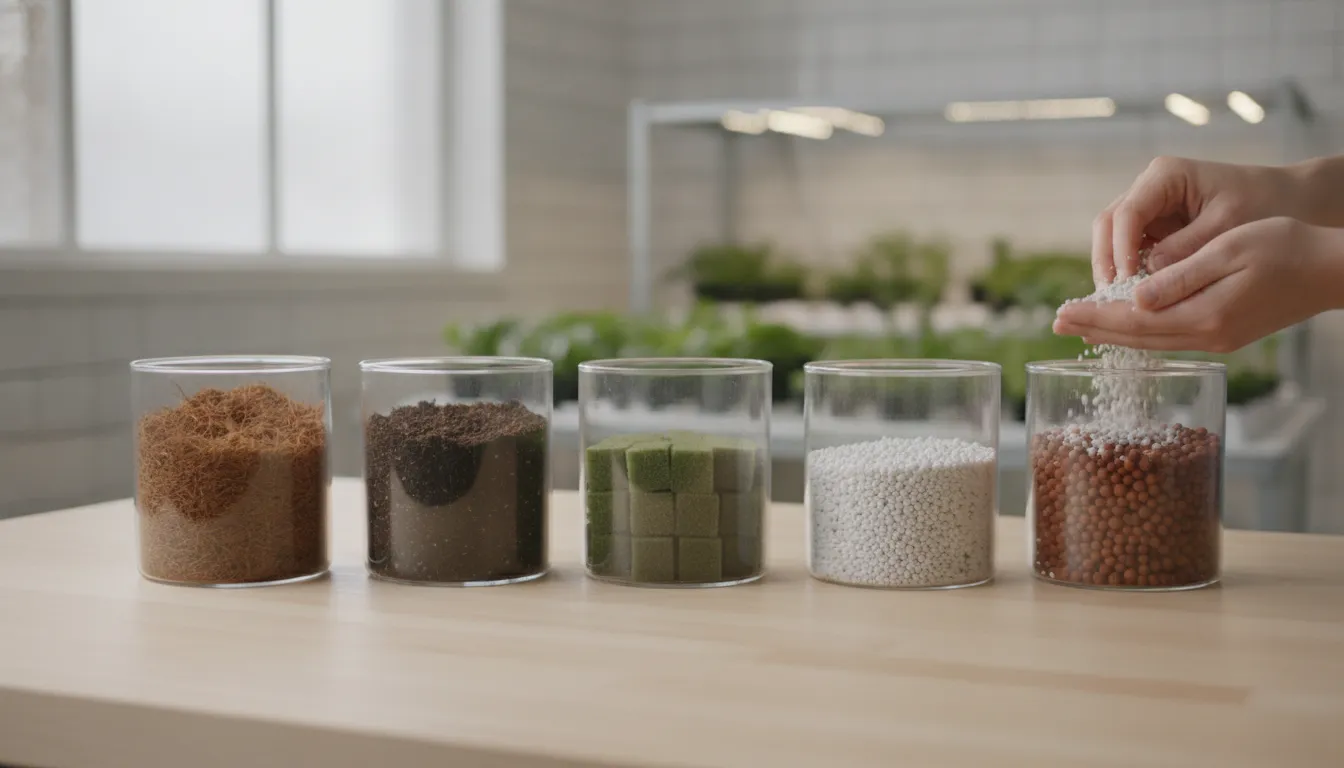
Coco coir and perlite
Coco coir plus perlite is a classic aerated mix. Coco coir holds moisture and provides structure, while perlite adds larger air spaces and improves drainage. This combination is useful when coco alone stays wetter than your watering routine allows. Start with a modest amount of perlite, then adjust after observing how quickly the container dries. A mix that remains saturated for too long may need more aeration, while one that dries rapidly may need more coco coir or more frequent irrigation.
Soil and perlite
Adding perlite to soil can reduce compaction and help excess water move through the container. This is especially helpful for indoor plants that are sensitive to consistently wet roots. Perlite is lightweight and inert, so it changes the physical structure without becoming a major source of nutrients. Mix it evenly rather than placing all of it at the bottom, where it will not reliably improve drainage throughout the root zone.
Media that should stay separate
Not every material belongs in one blended container. Rockwool is designed for controlled soilless and hydroponic systems, so mixing it into ordinary soil can create an inconsistent combination of moisture behavior and nutrient management. Use rockwool in a system built around its properties instead.
Clay pebbles are also usually better as a standalone hydroponic medium or as a deliberate layer for drainage and support. Blending a large quantity into soil or coco can create uneven pockets that dry at different rates. If you use clay pebbles, keep the watering method and container design aligned with their fast-draining, highly aerated structure. Mixing should solve a specific water-and-air problem, not simply add more materials.
How Often Should You Replace Your Growing Medium?
Growing medium does not have one universal expiration date. Its useful life depends on the material, how heavily it has been fed, how often it is irrigated, and whether it can be cleaned between cycles. Treat the following as practical ranges, not fixed rules. A well-maintained medium may last longer, while a compacted or contaminated medium should be replaced sooner.
Typical replacement ranges by medium
- Soil: Plan on replacing or substantially amending it after roughly one to two growing cycles. Soil can lose structure, compact, and accumulate unused nutrients over time. If it remains loose, drains well, and has no recurring pest problem, you may be able to refresh it with appropriate amendments rather than discard it.
- Coco coir: Coco commonly serves well for about two to three cycles when roots are removed and the material is rinsed and stored properly. It can break down and hold residual salts, so inspect it before reuse and follow a media-appropriate feeding plan.
- Rockwool: Rockwool may be used for roughly three to five cycles in some setups, but it should be evaluated carefully. Its structure can change after repeated use, and it is difficult to clean completely once roots are embedded. Replace it if drainage or root-zone consistency declines.
- Clay pebbles: Clay pebbles are often the most reusable option. Remove roots and debris, rinse thoroughly, and sanitize them according to your established growing routine before the next cycle. They should remain physically sound and drain consistently.
Signs it is time for a change
Replace media when it stays compressed after watering, drains unusually slowly, or dries unevenly. A crust or persistent salt buildup on the surface is another warning sign. Repeated pest issues, foul odors, algae, visible mold, or plant health problems that follow the medium from one cycle to the next also justify replacement. Do not try to extend its life simply to save material if the root zone is no longer predictable.
Before buying supplies for the next cycle, compare the condition of your medium with the demands of your setup.
Shop growing media and nutrients to match your plan
Frequently Asked Questions
Which growing medium gives faster results?
No medium guarantees faster results by itself. Coco coir and rockwool can support rapid growth when irrigation, nutrients, light, and airflow are well managed because they offer consistent control over water and air. Soil can perform just as well with sound watering practices, while perlite and clay pebbles are usually used to improve aeration or support a hydroponic system.
Does the growing medium change how often I need to water?
Yes. Soil generally holds moisture longer and is more forgiving if watering is delayed. Coco coir retains water while maintaining air space, but it may need more frequent, measured irrigation. Rockwool and clay pebbles can dry quickly, so they require closer monitoring or a dependable irrigation cycle. Perlite changes drying speed based on how much is blended into the mix.
Do I need different nutrients for each medium?
You need to adjust feeding to the medium. Soil can provide some nutrient buffering, while rockwool, perlite, and clay pebbles have little nutrient-holding capacity and depend more directly on the nutrient solution. Coco coir also commonly requires added calcium and magnesium as part of the feeding routine.
Can I reuse clay pebbles?
Yes. Clay pebbles can often be reused after they are thoroughly cleaned and inspected. Remove roots and residue, rinse away buildup, and discard pieces that are cracked or contaminated. Reuse is most practical when the pebbles remain physically sound and your sanitation process is consistent.
Ready to Set Up Your Indoor Growing Space?
Choosing the right medium is easier when your growing space, watering routine, and plant needs are working together. GroIndoor can help you gather the essential equipment for a more organized setup. Shop growing media, grow tents, and nutrients to get started with the supplies that fit your approach.
Tags: