


A reliable grow light schedule gives plants consistent light and a predictable dark period. The right hours depend on the plant, its stage, the strength and distance of the light, and any daylight from windows. Start with the plant or fixture guidance, set a repeatable timer, then change one factor at a time if plants show stress.

Explore lighting control options
What should a grow light schedule accomplish?
A schedule is more than a number of hours. It defines when the light turns on, when it turns off, how long the dark interval lasts, and whether natural daylight adds to the total. Consistency matters because a timer can repeat the same cycle every day, while manual switching often drifts.
Plants use light for growth, but they also respond to day length. Some plants flower or change growth behavior as days get longer or shorter. Others are less sensitive to day length. That means one schedule is not right for every crop or houseplant. Treat general hour ranges as a starting point, not a guarantee.
Think of three separate questions when planning:
- How much light reaches the leaves? Hours alone do not describe brightness or coverage.
- When does the light run? Choose an on/off pattern that is easy to maintain and does not conflict with natural daylight.
- Does the plant receive a dependable dark period? Avoid unplanned light leaks or interruptions when the plant's response depends on day length.
University of Minnesota Extension recommends supplemental lighting when indoor plants do not receive enough natural light and notes that timer settings should account for the total light plants receive. See its indoor plant lighting guidance for additional context.
How many hours should indoor grow lights run?
There is no universal schedule for every plant. Seedlings, herbs, leafy greens, flowering plants, and established houseplants may have different needs. Check the seed packet, plant-care guidance, or manufacturer instructions for the specific crop and light. Then account for light from windows and any other fixtures.
For many indoor growing situations, a long daily period of supplemental light may be useful, but no single duration suits every plant. A weak fixture may not deliver enough light in a given period. A powerful fixture placed close to leaves may cause stress even with a shorter schedule. Some plants also need a particular day length to flower or remain vegetative, so confirm species-specific needs before changing the timer.
When starting from seed, move emerging seedlings into bright light promptly and follow plant-specific directions. Illinois Extension lists insufficient or poorly positioned lighting among common seedling problems; its seed-starting troubleshooting guide is a useful reference. Oklahoma State University Extension also explains that LED design, light quality, coverage, and placement all affect plant production in its LED grow light overview.
| Growing situation | Scheduling starting point | What to verify before changing it |
|---|---|---|
| New seedlings | Use a consistent daily cycle based on the crop and light maker's directions; confirm the duration for the specific plant and fixture. | Seedling guidance, light distance, leaf response, and whether window light adds to the day. |
| Leafy herbs or greens | Choose a steady cycle that suits the crop and fixture, then keep the on/off times consistent. | Crop-specific recommendations, coverage across the canopy, and signs of heat or bleaching. |
| Day-length-sensitive plants | Set both the light period and uninterrupted dark period to match that plant's needs. | Reliable species guidance and any daylight or room light that reaches the plant after lights-out. |
| Houseplants receiving supplemental light | Use supplemental light to make up for the dimmer indoor location, rather than assuming a full grow-room schedule is needed. | Natural light at the plant's position, seasonal changes, and visible growth response. |
Use this table to organize decisions, not as a substitute for plant-specific instructions. If there is uncertainty about the plant's response to day length, preserve its current schedule while checking a reliable growing reference.
How do you set up a grow light timer?
A timer works best when the schedule is chosen deliberately and then left alone long enough to observe a response. Before changing anything, write down the current on and off times. Also note the fixture's distance from the canopy, whether there is window light, and which plants sit under each area.
- Group plants by need. Avoid putting plants with very different day-length needs on one timer if their schedules cannot be reconciled. Separate shelves or circuits may be easier to manage.
- Pick a practical start time. Choose a daily on-time that fits your routine and makes it easy to inspect plants while the lights are on. The exact clock time is usually less important than a stable cycle, unless the plant requires a specific photoperiod.
- Set the off-time from the desired duration. For example, if your verified plan calls for 14 hours, set the timer to turn off 14 hours after it turns on. Do not use this example as a universal recommendation.
- Check the timer's operation. Confirm the clock, AM/PM setting if applicable, outlet rating, and the intended daily repeat. Restore power after a brief outage only according to the timer's instructions.
- Observe one full cycle. Confirm that the light actually switches on and off at the programmed times. Check for other room lights that might interfere with darkness.
- Record the baseline. Keep a simple log of schedule, plant stage, light height, and visible symptoms. This makes later adjustments more informative.
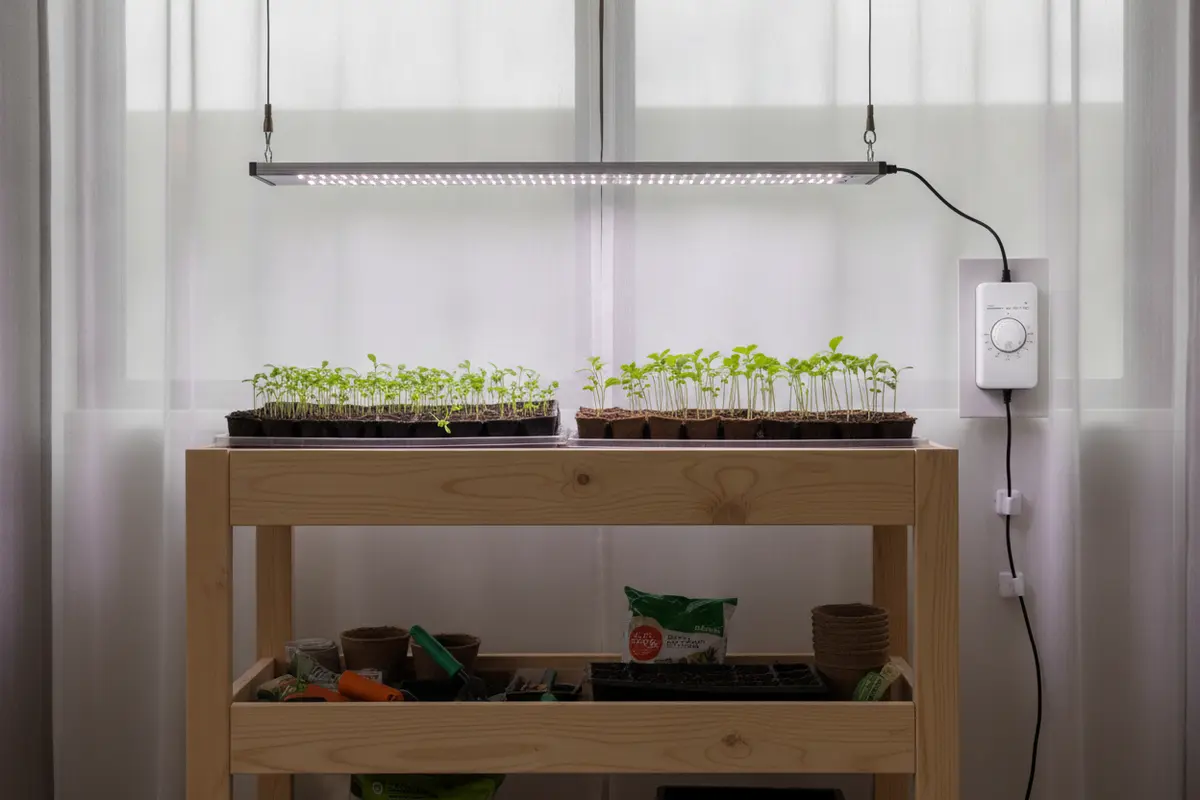
Use a controller rated for the equipment and follow its manual, especially when multiple fixtures or higher electrical loads are involved. A purpose-built lighting controller may suit a setup with more than one light, while growers seeking a simpler option can compare grow light timers. Check product specifications before connecting equipment.
Compare grow light timer options
How should you troubleshoot a schedule that is not working?
Plant symptoms can point toward lighting problems, but a symptom rarely identifies the schedule as the only cause. Water, nutrition, temperature, pests, and root conditions can produce similar changes. Avoid responding to every symptom by adding hours. First verify that the light is functioning and reaches the plant evenly, then review the timing.
Are seedlings becoming tall or leaning?
Leggy seedlings often stretch toward a light source when illumination is inadequate or poorly positioned. Check whether the fixture is too far away, the light period is too short for the crop, or the seedlings are receiving light from one direction. Rotate trays if the setup has uneven window light. Adjust fixture height within its instructions rather than immediately extending the schedule. Illinois Extension's seedling troubleshooting resource discusses light placement as one possible response to leggy growth.
Also inspect the spacing between plants and the coverage pattern. A long row may have bright centers and dim ends. A different fixture position or a more even arrangement can be more useful than adding hours to every plant.
Are leaves pale, bleached, curled, or unusually warm?
Excessive intensity, close placement, heat, or a sudden change in exposure may contribute to leaf stress. Check the fixture's recommended hanging height and coverage information. Raise or dim the light if the product allows it, and keep the schedule stable while observing new growth. Do not assume that fewer hours alone will solve a distance or heat problem.
If only the plants directly below the fixture show symptoms, inspect the center of the footprint and the fixture-to-canopy distance. If symptoms occur throughout the room, also check room temperature, airflow, and watering. You can compare fixture types and coverage details in the 1000-watt ballast collection or review a specific 600-watt grow bulb only if those products fit your existing lighting system; never assume different equipment has the same operating requirements.
Does the timer switch at the wrong time?
Check for an incorrect clock setting, an AM/PM mistake, a power interruption, an override switch, or a program that is not set to repeat daily. Test the outlet with a safe, compatible load if appropriate and inspect connections for damage. Do not handle electrical equipment with wet hands or around standing water. If a controller or wiring issue is unclear, stop and ask a qualified electrician.
After correcting the timer, watch at least one full programmed cycle. Keep a backup note of the intended schedule so the setting can be restored after a reset. A grow room accessory setup should not obscure access to switches, power strips, or the timer display.
Are plants responding differently across the room?
Uneven growth may be a coverage problem rather than an hours problem. Compare plants at the center and edges of the illuminated area. Check for obstructions, reflective surfaces, canopy height differences, and shadows cast by shelves or supports. Keep like-sized plants together when possible, and adjust their positions before changing the schedule for all of them.
Distance changes as plants grow. Recheck the gap between the fixture and the tallest leaves on a regular routine. Hanging hardware such as adjustable light hanging hooks can make small height corrections easier when compatible with the fixture. Follow its installation guidance and support the fixture securely.
Are day-length-sensitive plants flowering or changing at the wrong time?
Check whether the plant's day-length requirements are understood and whether the dark period is truly dark. Light from a hallway, nearby room, or an open tent can interrupt darkness. Verify timer accuracy and look for unexpected light leaks before changing the number of hours. Avoid switching between schedules frequently. If the plant's response depends on day length, use a trusted reference for that species and keep conditions consistent.
A grow tent can help define a dedicated growing area, but it does not automatically eliminate light leaks or make every schedule appropriate. Inspect seams, doors, and nearby sources of stray light while the room is otherwise dark.
How should you change a schedule without confusing the diagnosis?
Change one variable at a time. If you alter hours, fixture height, intensity, and watering in the same week, it becomes difficult to tell which change helped or caused a setback. Record the original settings, make a modest adjustment consistent with plant guidance, and observe the plant's new growth before making another change.
- Use a written log. Note date, on/off times, fixture height, dimmer setting if present, and the location of affected leaves.
- Look at new growth. Older leaves may not recover even when conditions improve. New leaves and overall posture are often more useful signals.
- Check the whole environment. Confirm temperature, water, and airflow rather than blaming the timer automatically.
- Keep the dark period consistent. Avoid turning lights on briefly during the off period to inspect plants if day length matters to that species.
- Reassess seasonally. Window light changes during the year. A schedule that worked in a bright season may need adjustment when daylight falls, and vice versa.
Do not treat a longer light day as a universal fix for slow growth. The fixture may be too weak, the plant may be shaded, or another growing condition may be limiting development. Iowa State University Extension describes different sources of supplemental lighting and their use for indoor plants in its supplemental light overview. Use such guidance alongside information for your specific plant and equipment.
What common scheduling mistakes should you avoid?
- Copying another grower's hours without checking the crop. Species, growth stage, and fixture strength all matter.
- Counting every hour as equal. A few hours of weak light through a shaded window do not necessarily equal the same duration under a strong fixture.
- Changing the timer repeatedly. Frequent changes make plant response harder to interpret.
- Ignoring natural daylight. The light from a nearby window can add to the daily exposure, even if it changes with the season.
- Forgetting darkness. Some plants respond to uninterrupted night length, so random light leaks may matter as much as the programmed cycle.
- Using a timer outside its rating. Confirm that the timer or controller is suitable for the connected equipment and follow manufacturer instructions.
- Assuming a timer fixes poor placement. Schedule cannot compensate for uneven coverage, excessive distance, or a fixture that is not appropriate for the growing area.
Before replacing equipment, make a small troubleshooting checklist: verify the clock, observe one on/off cycle, check light distance and coverage, and compare symptoms with a plant-specific reference. If the growing space itself needs adjustment, review the dimensions and layout of a suitable 3x5 grow tent as one possible setup component, while keeping plant needs and fixture coverage in view.
How can you tell whether the new schedule is helping?
Choose an observation period appropriate to the plant's growth rate. For seedlings or fast-growing herbs, check frequently for new growth and changes in posture. For slower-growing plants, allow more time before deciding whether the adjustment worked. Avoid promising a fixed recovery time because species and conditions vary.
Look for a pattern rather than a single leaf. Are new leaves developing normally? Are seedlings less stretched? Is the canopy receiving more even light? Are symptoms stable rather than spreading? If the answer is no, return to the written baseline and investigate other conditions. When a fixture is involved, check its instructions for distance, dimming, and coverage. Safety matters too: grow room eyewear may be appropriate for viewing some bright lighting setups, but follow the light manufacturer's eye-safety guidance.
Compare lighting control options
Frequently Asked Questions
Should grow lights run during the day or at night?
Either can work for many indoor setups if the daily cycle is consistent and fits the plant's needs. Consider household routines, heat, and natural daylight. If the plant is sensitive to day length, prioritize its required light and dark periods over convenience.
Can I leave a grow light on all day?
Do not assume continuous light is appropriate. Many plants need a dark period, and day-length-sensitive plants may respond to the timing of darkness. Follow guidance for the particular plant and avoid extending the cycle as a default response to poor growth.
How often should I adjust the timer?
Keep a working schedule stable unless plant guidance or clear observations point to a reason to change it. Make one adjustment at a time, write it down, and watch new growth before making another change. Recheck as plants grow or window light changes seasonally.
Why do plants look stressed even when the timer is correct?
A correct timer setting does not guarantee correct light intensity, distance, or coverage. Water, temperature, airflow, nutrition, pests, and root conditions can also affect plants. Check the full growing environment and the fixture instructions before changing the schedule again.
Get started with a dependable schedule
Set a consistent cycle based on the plant, verify the timer, and record the starting conditions. When symptoms appear, inspect intensity, distance, coverage, and other growing factors before changing the hours. A measured adjustment and a clear log make it easier to learn what works in your indoor garden.
Tags: